Eating independently can become more difficult when tremors, arthritis, weakness, or limited hand control affect the way you hold standard silverware. The best ergonomic adaptive utensils are designed to improve stability, comfort, and control during everyday meals.
This roundup compares 10 adaptive utensil sets with features such as angled heads, weighted construction, bendable shafts, built-up grips, non-slip surfaces, and wrist straps. Use the guide below to narrow your options based on the user’s specific needs.
Best 10 Ergonomic Adaptive Utensils Picks for 2026
Best Angled Weighted Pick

- 42° angle helps reduce wrist rotation
- 2.5-ounce weight adds stability
- Built-up silicone grips support control
Best For: Right-handed users needing angled, weighted support for tremors or limited dexterity
Best Adjustable Grip

- Bendable fork and spoons customize positioning
- Wide grips support weak hand strength
- Suitable for right- and left-handed users
Best For: Users seeking customizable utensil angles and a broad, supportive grip
Best Everyday Weighted Set
Non-Slip Weighted Adaptive Flatware

- Built-up non-slip handles improve grip
- Four-piece set covers daily meals
- Stainless steel and dishwasher-safe design
Best For: Everyday use by seniors or adults needing added stability and grip support
Best Simple Grip Support
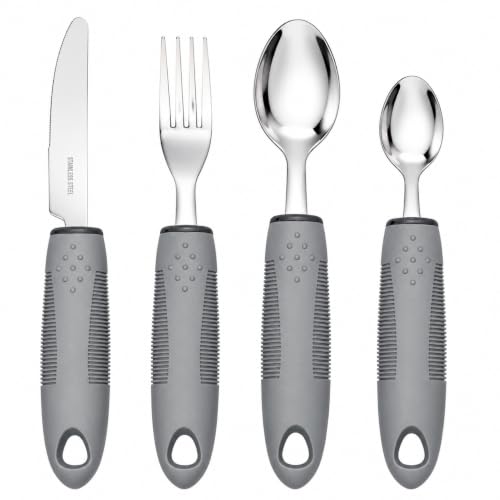
- Non-slip handles help reduce fatigue
- Supports varied dexterity challenges
- Dishwasher-safe, food-safe construction
Best For: Users wanting straightforward grip assistance for everyday independent eating
Complete Tableware Set

- Two sets provide 10 total utensils
- Includes knives, curved knives, forks, and spoons
- Wider non-slip handles support easier gripping
Best For: Households needing versatile adaptive tableware for multiple meal tasks
High-Visibility Swivel Pick

- Adjustable strap helps secure the utensil
- 360-degree swivel supports multiple eating angles
- Bright red color improves table visibility
Best For: Users with limited hand mobility who value secure handling and high visibility
Best Overall

- 45-degree angle helps limit wrist rotation
- Balanced 2.6–3-ounce design for tremor control
- Four-piece dishwasher-safe place setting
Best For: Right-handed users needing a complete adaptive dining set
Most Adjustable
Weighted Adjustable Spoon and Fork

- 180-degree angle adjustment
- Weighted design supports steadier handling
- Wide grip works for left- and right-handed users
Best For: Users who need customizable positioning and broad hand compatibility
Best Angled Weighted Pick – 42° Angled Weighted Utensils
These ergonomic adaptive utensils combine a 42° angled design with 2.5-ounce weighting to support steadier, more comfortable eating. The built-up silicone handles are intended to reduce wrist rotation and improve grip for users with tremors, arthritis, or limited hand mobility.
Best For: Right-handed seniors and adults with Parkinson’s, hand tremors, arthritis, or reduced dexterity who want angled, weighted cutlery.
Pros:
- Angled design can reduce wrist rotation during meals.
- 2.5-ounce weighting provides added stability without excessive bulk.
- Large, textured silicone handles support an easier grip.
- Stainless steel eating surfaces and dishwasher-safe construction suit daily use.
Cons:
- This listed version is specifically right-handed.
- Weighted utensils may not suit users who prefer very lightweight flatware.
Choose this set when wrist positioning and tremor support are higher priorities than maximum versatility. Its four-piece configuration covers common meals, while the angled, weighted design provides more specialized assistance.
Best Adjustable Grip – Bendable Adaptive Utensils
For shoppers who need ergonomic adaptive utensils that can be customized, this four-piece set offers bendable fork, tablespoon, and teaspoon components. The wide-grip handles and adjustable positioning are designed to improve control for users with arthritis, tremors, Parkinson’s, or weak grip strength.
Best For: Right- or left-handed users who want bendable utensils that can be positioned to match their preferred eating angle.
Pros:
- Fork, tablespoon, and teaspoon can be bent into a preferred position.
- Works for both right- and left-handed users.
- Wide grip and handle ribs provide added palm support.
- Dishwasher safe up to 125 degrees.
Cons:
- The notes do not specify that the set is weighted.
- Bendable components may require adjustment to find the most comfortable position.
This is the most flexible choice in the group for users who need personalized utensil angles rather than added weight. Its ambidextrous design also makes it practical for shared households or changing hand needs.
Best Everyday Weighted Set – Non-Slip Weighted Adaptive Flatware
This set is a straightforward option for ergonomic adaptive utensils, pairing weighted-style pieces with built-up, non-slip handles. It is designed to provide more stability and control for people with Parkinson’s, hand tremors, arthritis, weak grip strength, or limited dexterity.
Best For: Seniors and adults who want a complete, durable set for everyday meals, home care, or assisted living.
Pros:
- Built-up textured handles offer a more secure hold than thin flatware.
- Includes a tablespoon, teaspoon, fork, and knife.
- Rust-resistant stainless steel is intended for daily use.
- Dishwasher safe for convenient cleanup.
Cons:
- The notes describe the pieces as weighted-style but do not provide a specific weight.
- The set’s handle shape may feel larger than standard silverware.
Consider this set if you want practical tremor- and grip-oriented features without a specialized angled design. Its complete place setting and easy-clean construction make it a balanced everyday option.
Best Simple Grip Support – Senior Adaptive Utensils Set
These ergonomic adaptive utensils focus on the essentials: non-slip handles, an easy-to-hold design, and a complete set for independent eating. They are intended for seniors and users with tremors, weak hand grip, arthritis, Parkinson’s, stroke recovery, or other motor-skill challenges.
Best For: Users seeking a simple, versatile adaptive set with comfortable non-slip handles for routine meals.
Pros:
- Non-slip handles are designed to reduce hand fatigue.
- Suitable for several conditions affecting strength or dexterity.
- Includes a fork, knife, spoon, and additional utensil.
- Food-safe, sturdy materials are dishwasher safe.
Cons:
- The notes do not specify weighting, handle dimensions, or a bendable design.
- It may offer less specialized support than angled or weighted alternatives.
This set is a sensible starting point when basic grip assistance and versatility matter most. Choose another option if you specifically need measured weighting, an angled utensil, or adjustable positioning.
Adjustable Stability Pick – Custom-Weight Swivel Utensils
These ergonomic adaptive utensils are designed for users who need steadier handling without giving up flexibility. The removable base cap lets you customize the weight with household materials, while the non-slip handle, wrist strap, and adjustable swivel head support more controlled eating.
Best For: Adults with hand tremors, weak grip, Parkinson’s, arthritis, or changing stability needs who want a fork-and-spoon set.
Pros:
- Customizable weight can be increased or reduced as needed.
- 360-degree swivel head adjusts for left- or right-handed use and helps reduce wrist twisting.
- Stainless steel and food-grade silicone construction is dishwasher safe, with detachable heads for cleaning.
- Extended handle, large spoon bowl, non-slip grip, and wrist strap support independent use.
Cons:
- The set includes only one fork and one spoon.
- Steel beads shown in the images are not included; added weight requires household materials or separate weights.
- The adult-sized design should be checked against the size chart before ordering.
This is the most adaptable option of the three for users whose stability needs vary. Its customizable weight and locking swivel mechanism add versatility, while the compact two-piece format keeps the set focused on essential meals.
Complete Tableware Set – 10-Piece Adaptive Utensils
For shoppers seeking ergonomic adaptive utensils for several meal tasks, this Uiifan set provides two 10-piece assortments. The wider silicone-and-plastic handles are designed for easier gripping, while the mix of forks, spoons, knives, and curved knives covers cutting, slicing, spearing, and scooping.
Best For: Households that want multiple adaptive utensils for daily meals, backups, or different food-preparation tasks.
Pros:
- Two sets totaling 10 pieces provide broad meal coverage and fewer wash cycles.
- Includes forks, dinner spoons, soup spoons, knives, and curved knives for one-handed cutting.
- Wider non-slip handles are intended to improve grip and reduce hand fatigue.
- Stainless steel is described as corrosion- and rust-resistant, while the handles are designed for comfortable use.
Cons:
- The utensils are non-weighted, so they may not suit users who benefit from added utensil weight.
- The average 7.5-inch length and handle dimensions may not fit every hand or preference.
- The larger set may be more than needed for someone seeking only a basic fork-and-spoon solution.
This set stands out for quantity and variety rather than specialized stabilization. It is a practical choice when adaptive tableware needs to cover complete meals, shared household use, or frequent washing.
High-Visibility Swivel Pick – Red Strap-Handle Utensils
These ergonomic adaptive utensils combine a secure adjustable strap with a 360-degree swivel design. The bright red fork and spoon are intended to improve visibility at the table, while the rounded food-grade stainless steel edges and multi-angle adjustment support users with limited hand mobility.
Best For: Adults with tremors, arthritis, neuropathy, reduced grip strength, or rehabilitation-related mobility limits who may benefit from high-visibility utensils.
Pros:
- Adjustable strap and non-slip handle help keep the utensil stable in the hand.
- 360-degree multi-angle adjustment accommodates left- and right-handed use.
- Bright red color may make the utensils easier to identify and is intended to support appetite for some users.
- Food-grade stainless steel with polished, rounded edges is designed for comfortable eating.
Cons:
- The set includes a fork and spoon but does not include a knife or other tableware pieces.
- The bright red finish may not suit users who prefer neutral-colored utensils.
- The product’s swivel design may require adjustment to find the most comfortable angle.
This option is especially appealing when visibility and hand security are priorities. It offers angle flexibility similar to specialized swivel utensils, with a strap and high-contrast color that may be useful in home, care, or rehabilitation settings.
Best Overall – Angled Weighted Utensil Set
This four-piece set combines a 45-degree angle, balanced weight, and oversized silicone grips, making it a practical option when comparing ergonomic adaptive utensils for tremors, arthritis, or reduced dexterity.
Best For: Right-handed seniors and adults with Parkinson’s, hand tremors, arthritis, or limited grip strength who want a complete everyday place setting.
Pros:
- 45-degree angled design can reduce wrist rotation and fatigue.
- Balanced 2.6–3-ounce construction is intended to help steady hand tremors.
- Includes a fork, knife, tablespoon, and soup spoon with non-slip silicone handles.
- Food-grade stainless steel heads are dishwasher safe.
Cons:
- Designed specifically for right-handed users.
- The weighted construction may not suit users who prefer lightweight utensils.
Choose this set if you need more than a spoon-and-fork pair and value coordinated utensils for daily meals or assisted dining.
Most Adjustable – Weighted Adjustable Spoon and Fork
Adaptive Utensils Weighted Spoon Fork Set for Hand Tremors, Parkinson's & Arthritis
Check Price On AmazonFor shoppers comparing ergonomic adaptive utensils with flexible positioning, this spoon-and-fork set pairs weighted construction with 180-degree angle adjustment and a wide textured handle.
Best For: Left- or right-handed users with tremors, arthritis, weak grip, stroke recovery needs, or limited mobility who need customizable utensil positioning.
Pros:
- 180-degree adjustment allows users to customize the utensil angle.
- Weighted construction is designed to provide counterbalance resistance for shaking hands.
- Wide, non-slip handle accommodates reduced finger dexterity and various hand sizes.
- Food-grade 304 stainless steel and dishwasher-safe construction support daily use.
Cons:
- Includes only a spoon and fork, not a knife or additional serving pieces.
- At 8.01 ounces, it may be less suitable for users who need very lightweight cutlery.
This is the most versatile pick of the three when adjustability and left- or right-hand compatibility matter more than having a full utensil set.
Best Lightweight Option – Angled Silicone-Grip Utensils
This compact two-piece set offers a right-hand angled spoon and fork with lightweight construction, making it a straightforward choice for shoppers seeking ergonomic adaptive utensils without added weight.
Best For: Right-handed users with tremors, Parkinson’s, limited mobility, or age-related dexterity challenges who prefer lightweight utensils.
Pros:
- Curved angled design supports self-feeding with less wrist turning.
- Lightweight, non-weighted construction may be easier to lift.
- Food-grade silicone handles feature textured surfaces for a more secure grip.
- Dishwasher safe below 120°C/248°F.
Cons:
- Set includes only a spoon and fork.
- Designed for right-handed use and does not offer angle adjustment.
- Non-weighted construction may provide less tremor stabilization than weighted alternatives.
Consider this set when low weight, simple angled positioning, and easy cleaning are higher priorities than tremor-counterbalancing weight or all-purpose coverage.
How We Picked the Best Ergonomic Adaptive Utensils
We focused on the features that most directly affect eating comfort and control: handle shape, grip security, utensil weight, angle adjustability, wrist support, and the range of included pieces. We also considered whether a set is suited to tremors, arthritis, reduced grip strength, Parkinson’s-related movement difficulties, or general limited dexterity.
Because adaptive utensils work differently for each person, there is no single best design for everyone. A heavier spoon may reduce shaking for one user but cause fatigue for another, while an angled or bendable head may improve reach and positioning without adding weight.
Quick Comparison
| Feature | Best suited to | What to consider |
|---|---|---|
| Weighted utensils | Hand tremors and involuntary movement | Check total weight to avoid fatigue. |
| Angled or curved heads | Limited wrist or arm mobility | Confirm whether the angle is fixed or adjustable. |
| Built-up handles | Arthritis and weak grip | Look for a comfortable diameter and non-slip finish. |
| Bendable utensils | Personalized hand and wrist positioning | Adjust gradually and verify the shaft stays secure. |
| Wrist straps or swivel heads | Very limited grip control | Make sure the support feels secure without restricting movement. |
Key Buying Factors for Ergonomic Adaptive Utensils
Weight and Balance
Weight can dampen tremors and make a utensil feel more stable, but heavier is not always better. Choose a lighter design for users who tire easily or have limited arm strength, and consider a weighted option when shaking is the primary challenge.
Handle Comfort and Grip
Built-up, contoured, and non-slip handles can reduce the finger pressure needed to hold a fork or spoon. Measure the user’s preferred grip if possible, and avoid handles that are too wide to control comfortably.
Angle and Adjustability
Angled heads can help users bring food to the mouth with less wrist rotation. Bendable models offer more customization, while fixed-angle utensils may be simpler and more consistent for daily use.
Set Contents and Cleaning
Check whether the package includes the pieces the user actually needs, such as a fork, teaspoon, tablespoon, and knife. Dishwasher compatibility, removable straps, and corrosion-resistant materials can make routine cleaning easier.
Who Should Buy Which Ergonomic Adaptive Utensils?
- For hand tremors: Start with a moderately weighted set, especially one with a stable, non-slip handle.
- For arthritis or weak grip: Prioritize thick, cushioned, easy-grip handles over added weight.
- For limited wrist movement: Choose angled or bendable utensils that reduce the need to twist the wrist.
- For very limited hand control: Consider wrist straps or swivel-style designs, ideally with guidance from an occupational therapist.
- For caregivers and shared households: Look for complete four-piece sets that are easy to clean and simple to identify.
If difficulty eating is new, worsening, or accompanied by swallowing problems, consult a healthcare professional or occupational therapist. The right adaptive utensil should support independence without causing pain, strain, or unsafe eating mechanics.