Putting on socks can become difficult when bending, reaching, or maintaining balance is limited. The right sock aid can make dressing more independent while reducing unnecessary strain on the hips, knees, and back.
We selected 10 sock aids for elderly users, including simple stocking sliders, wider models, combination kits, and options designed for compression hosiery. Use the guide below to match the design to the user’s mobility, sock type, and daily routine.
Best 10 Sock Aids for Elderly Picks for 2026
Comfort-Grip Favorite

- Foam-padded handles
- Adjustable 33-inch cords
- Slip-resistant sock cuff
Best For: Seniors needing a comfortable, adjustable sock aid
Compact Soft-Shell Pick

- Flexible ABS shell
- U-shaped sock opening
- Fits feet up to 4 inches wide
Best For: Users with narrower feet wearing regular socks
Two-in-One Dressing Aid

- Sock aid and shoe horn combo
- Long handle reduces bending
- Hook handle helps remove socks
Best For: Adults needing help with both socks and shoes
Wider-Fit KEKOY

- Fits feet up to 4.6 inches wide
- Flexible U-shaped ABS shell
- FSA or HSA eligible
Best For: Users needing a wider regular-sock aid
Best Gentle-Grip Pick

- Three-finger design holds socks securely
- Terrycloth and nylon covering reduces friction
- Lightweight option for everyday socks
Best For: Regular dress, casual, and athletic socks
Best for Compression Socks

- Wide design helps socks stay in place
- Comfortable ergonomic handles
- Suitable for compression stockings
Best For: Users with bending difficulty or compression socks
Best Extended-Reach Kit

- 33-inch rope reduces bending
- 4-inch tube with anti-slip foam
- Includes an 18.5-inch sock remover
Best For: Users needing extra reach for regular socks
Easy-Grip Terry Sock Aid
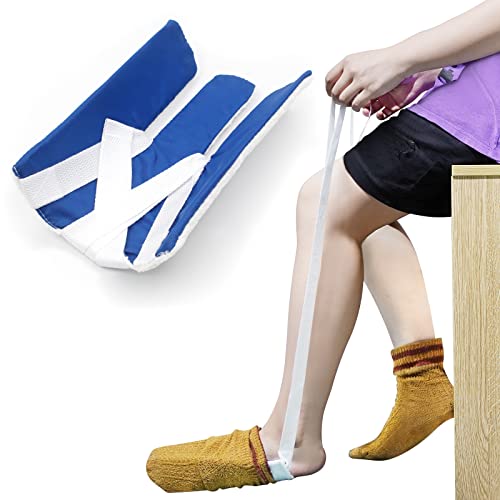
- Lightweight design for everyday use
- Terry cloth helps hold socks in place
- Works with multiple sock styles
Best For: Seniors and users who need help dressing without bending
Compression Sock Aid Kit

- Supports medium- to high-elasticity socks
- Includes a detachable multifunctional dressing stick
- Ergonomic handle helps reduce bending
Best For: Compression-sock users who also need broader dressing assistance
DMI Deluxe Sock Aid
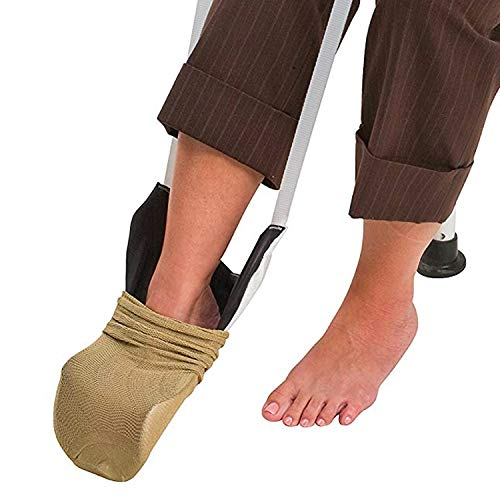
- Usable sitting or standing
- Terry cover helps prevent slipping
- Includes a 1-year warranty
Best For: Adults and seniors with limited range of motion
Comfort-Grip Favorite – Vive Sock Aid
For shoppers comparing sock aids for elderly users, the Vive Sock Aid focuses on comfortable handling and straightforward sock placement. Its contoured plastic shell, padded handles, and adjustable cords are designed to help users pull on socks without excessive bending.
Best For: Seniors and people recovering from surgery, injury, or limited mobility who want padded grips and adjustable reach.
Pros:
- Contoured shell helps slide over the foot and heel.
- 3 cm foam-padded handles provide a more comfortable grip.
- Slip-resistant cuff helps keep the sock on the aid.
- 33-inch cords can be adjusted with button adjustors.
Cons:
- Noted care instructions specify hand washing only.
- The supplied information does not specify compatibility with compression socks.
This is a practical choice when grip comfort and adjustable cord length matter most. The included 60-day Vive guarantee adds purchase reassurance.
Compact Soft-Shell Pick – KEKOY 4-Inch Sock Aid
This KEKOY model is a simple option among sock aids for elderly users who need help dressing without bending down. Its flexible U-shaped ABS shell is designed to hold the sock opening in place while the foot slides through.
Best For: Users with feet measuring 4 inches (10.2 cm) or less who wear regular ankle, knee, calf, sports, or dress socks.
Pros:
- Soft, flexible ABS shell is designed for easier sock insertion.
- U-shaped design helps maintain the sock opening.
- Supports independent dressing for users with arthritis, limited mobility, or recovery needs.
Cons:
- Suitable only for foot widths of 4 inches (10.2 cm) or less.
- Not intended for compression socks or compression stockings.
Check the foot-width limitation before ordering. For compatible feet and regular socks, the soft-shell design offers a focused, no-bending dressing aid.
Two-in-One Dressing Aid – DMI Sock Aid & Shoe Horn
For anyone comparing sock aids for elderly users, the DMI combines a sock aid and shoe horn in one dressing tool. Its long handle supports a three-step process intended to reduce bending, stretching, and straining while putting on socks and shoes.
Best For: Seniors and adults with limited movement who want one tool for both socks and shoes.
Pros:
- Combines a sock aid with a shoe horn.
- Long handle helps users dress without bending.
- Hook handle can help remove socks and provide extra support.
- Designed for use with any type of sock or shoe, according to the supplied notes.
Cons:
- Requires assembly, including securing the base and handle.
- A screwdriver is required, although screws and a screwdriver are included.
- The assembled unit weighs 16 ounces.
The DMI stands out for versatility rather than minimal setup. Its four-piece construction takes assembly, but the combination format may be worthwhile for users who also need shoe-donning assistance.
Wider-Fit KEKOY – KEKOY 4.6-Inch Sock Aid
This wider KEKOY model is worth considering when standard sock aids for elderly users may be too narrow. Its soft U-shaped ABS shell is designed for feet up to 4.6 inches (11.6 cm) wide and helps keep the sock opening stable while the user slides a foot through.
Best For: Users with feet measuring 4.6 inches (11.6 cm) or less who wear regular, non-compression socks.
Pros:
- Accommodates a foot width up to 4.6 inches (11.6 cm).
- Flexible ABS shell supports easier sock insertion.
- U-shaped design helps keep the sock opening in position.
- FSA or HSA eligible, according to the supplied notes.
Cons:
- Not suitable for feet wider than 4.6 inches (11.6 cm).
- Not intended for compression socks or compression stockings.
Compared with the smaller KEKOY version, this model offers a wider fit while retaining the same general soft-shell approach. Confirm your foot width and sock type before choosing it.
Best Gentle-Grip Pick – CAidRE Sock Aid
The CAidRE is a straightforward choice among sock aids for elderly users who want to put on everyday socks without bending, twisting, or turning. Its three-finger design and fabric covering are intended to hold socks securely while reducing friction during use.
Best For: Seniors, pregnant users, disabled users, and people with mobility limitations who wear regular dress, casual, or athletic socks.
Pros:
- Three-finger design helps hold stockings and socks in place.
- Terrycloth exterior and nylon interior provide a gentle yet firm grip.
- Compact, lightweight design measures 8.85 by 4.72 by 2.36 inches and weighs 2.4 ounces.
Cons:
- The manufacturer notes that it does not work well with compression socks.
- It may be less suitable for users who need a long-handled aid.
Choose this model if comfort and a simple, lightweight design matter most. For compression stockings or users who prefer extended handles, consider a different style.
Best for Compression Socks – SOKELP Sock Aid
The SOKELP stands out among sock aids for elderly users who want a wide, comfortable device for putting on socks while seated. Its full-width foam pad, soft-touch coating, and ergonomic handles are designed to improve grip and reduce pressure on the fingers.
Best For: Adults dealing with bending difficulty, osteoarthritis, sciatica, hip surgery recovery, or discomfort when putting on regular or compression socks.
Pros:
- Wide sock aid with a full-width foam pad helps keep socks from slipping.
- Ergonomic, breathable handles are designed for comfortable gripping.
- Soft-touch coating, polished edges, and a curved base support comfortable use.
- Designed for use with compression stockings as well as other socks.
Cons:
- At 7.05 ounces, it is heavier than some simpler sock aids.
- The wider design may require more storage space than compact models.
This is a strong option when handle comfort and support for compression stockings are priorities. Its wider construction may be especially helpful for users who want to avoid bending or twisting.
Best Extended-Reach Kit – Jellas Sock Aid
The Jellas kit is a practical choice among sock aids for elderly users who need extra reach while dressing. Its 33-inch rope and 18.5-inch assembled remover are designed to reduce bending, while the 4-inch tube accommodates many regular socks.
Best For: Seniors and people with back, knee, hip, leg, or foot limitations who need a longer-reach aid for regular socks and long stockings.
Pros:
- 33-inch rope helps reduce bending and can be shortened with knots.
- 4-inch-wide tube uses anti-slip foam to help hold socks in place.
- Assembled sock remover reaches 18.5 inches for added accessibility.
- Suitable for many regular socks and long stockings.
Cons:
- The notes say it is not best for compression socks.
- Using nails to reinforce the assembly makes the remover difficult to take apart.
- Arm injuries may affect the user experience.
Consider this kit if reach and reduced bending are more important than compact storage. Its adjustable rope adds flexibility, but users should plan how they want to assemble and store the remover.
Easy-Grip Terry Sock Aid – No-Bend Sock Helper
For shoppers comparing sock aids for elderly users, this lightweight helper is designed to make putting on everyday socks easier without bending, twisting, or turning. Its terry cloth and nylon construction is intended to hold the sock while reducing friction as it slides into place.
Best For: Seniors, people with limited mobility, disabled users, and pregnant users who need help putting on ankle, knee, calf-length, athletic, trouser, or compression socks.
Pros:
- Helps users put on socks with little effort and without bending.
- Terry cloth helps hold the sock, while nylon is designed to reduce friction.
- Works with several common sock styles, including compression socks.
- Compact and lightweight at 9 x 5.12 x 2.17 inches and 2.4 ounces.
Cons:
- The supplied details do not specify a care method or a fit range.
- Although listed for compression socks, compatibility can vary by sock tightness and elasticity.
This is a straightforward option for users who want a compact sock donner with a fabric-lined design and broad everyday sock compatibility.
Compression Sock Aid Kit – Dressing Stick Included
This kit stands out among sock aids for elderly users by combining a plastic-shell device for medium- to high-elasticity compression socks with a detachable dressing stick. The ergonomic handle is intended to help users put on socks when bending or reaching is difficult.
Best For: People recovering from back, knee, or hip replacement surgery, users with limited flexibility or strength, and seniors who want added dressing assistance.
Pros:
- Plastic shell is designed to support medium- to high-elasticity compression socks.
- Ergonomic grip handle helps users put on socks with less bending.
- Detachable dressing stick includes interchangeable plugs for scratching, shoe assistance, and clothing assistance.
- Provides a broader dressing-aid kit rather than only a sock helper.
Cons:
- The product is substantially larger and heavier than a basic fabric sock aid, with a package weight of 2.45 pounds.
- The plastic head may feel somewhat hard, according to the supplied product information.
- The replaceable attachments may add setup and storage considerations.
Choose this option if compression socks and multifunctional dressing support are priorities; a simpler sock aid may be more practical for users who only need help with standard socks.
DMI Deluxe Sock Aid – Slip-Resistant Terry Helper
The DMI Deluxe is a traditional choice among sock aids for elderly users who want to pull on socks without bending. Its terry cloth cover is designed to help prevent slipping, while the nylon lining reduces friction for users with limited range of motion or those recovering from surgery.
Best For: Seniors and adults with limited mobility or range of motion, including people recovering from hip, knee, or back surgery.
Pros:
- Can be used while sitting or standing.
- Terry cloth cover helps keep the sock from slipping during use.
- Nylon lining is designed to reduce friction.
- Includes a 1-year warranty and a clearly specified hand-wash care routine.
Cons:
- The supplied details do not provide product dimensions or weight.
- It is intended for tube socks, so users should confirm compatibility with specialized sock styles.
- Must be hand washed with mild detergent and hung to dry; machine washing is not recommended.
This is a sensible pick for shoppers who value a familiar, fabric-covered design, slip resistance, and documented care instructions over extra dressing-stick functions.
How We Picked These Sock Aids for Elderly Users
We focused on practical features that affect everyday dressing: how easily a sock loads onto the device, whether the user can pull it into place without bending, the width of the foot opening, handle or cord control, stability, storage, and compatibility with different sock materials. The selection also includes models for users who need a shoe horn, dressing stick, or extra help with compression stockings.
Because mobility needs vary, no single design is best for everyone. A wider slider may be easier for swollen feet, while a compact model may be preferable for travel or limited storage.
Quick Comparison
| Best For | Look For |
|---|---|
| Everyday socks | Simple rigid slider with easy-pull cords |
| Wide or swollen feet | Opening around 4.6 inches or a flexible design |
| Limited hand strength | Large handles, strong cords, and a non-slip sock cradle |
| Compression stockings | Purpose-built compression aid with reinforced construction |
| Multiple dressing tasks | Kit with a shoe horn or dressing stick |
| Small spaces | Lightweight design that stores or disassembles easily |
Key Buying Factors for Sock Aids for Elderly Users
Opening Size and Sock Compatibility
Check the device’s stated width against the user’s foot and ankle. Standard cotton socks are usually easiest, while thick athletic socks, loose hosiery, and compression socks may require more room or a specialized aid. Confirm the product’s compatibility before buying.
Grip, Cords, and Control
Pull cords should be long enough to reach comfortably without excessive bending. Handles with larger loops or textured surfaces are helpful for arthritis, weak grip, or reduced dexterity. A sock cradle that holds fabric securely can prevent repeated attempts.
Stability and Ease of Loading
A rigid frame is often simpler to load, while flexible designs can feel more comfortable around the foot. Look for smooth edges, a non-slip interior, and a shape that stays upright while the sock is fitted.
Compression and Swelling Needs
Compression stockings are harder to stretch than ordinary socks. Choose a model specifically intended for compression hosiery rather than assuming a standard slider will work. Users with significant swelling or circulation concerns should follow their clinician’s guidance.
Who Should Buy Which Sock Aids for Elderly?
Choose a basic sock aid for someone who mainly needs help avoiding bending but has adequate hand control. Select a wider model for larger feet, swollen ankles, or thicker socks. A combination kit makes sense when the user also struggles with shoes or other dressing tasks. For compression stockings, prioritize the dedicated compression option and verify sizing carefully.
If balance is poor, use the aid while seated on a stable chair and avoid rushing. A caregiver or occupational therapist can demonstrate the safest loading and pulling technique, especially after surgery or a major change in mobility.