Finding the right adaptive utensils for one-handed use can make everyday meals more comfortable, controlled, and independent. This roundup compares lightweight, weighted, angled, bendable, and built-up-handle designs for people managing tremors, arthritis, Parkinson’s, weakness, or limited hand mobility.
Use the guide below to match the utensil style, grip, weight, and adjustability to the user’s abilities and dining routine.
Best 10 Adaptive Utensils for One Handed Use Picks for 2026
Best Travel-Ready Set

- Four-piece set with rocker knife
- Soft, lightweight foam grips
- Includes reusable canvas travel wrap
Best For: Portable everyday dining for users with tremors or weak grips
Best Plate-Stabilizing Aid
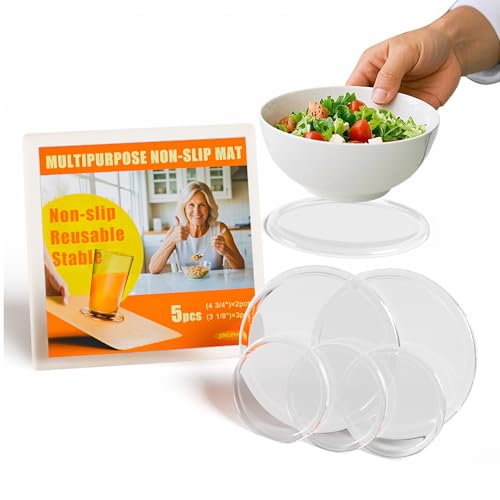
- Five reusable anti-slip mats
- Helps secure plates and bowls
- May support one-handed bottle opening
Best For: Stabilizing dinnerware during one-handed meals
Best Lightweight Built-Up Set
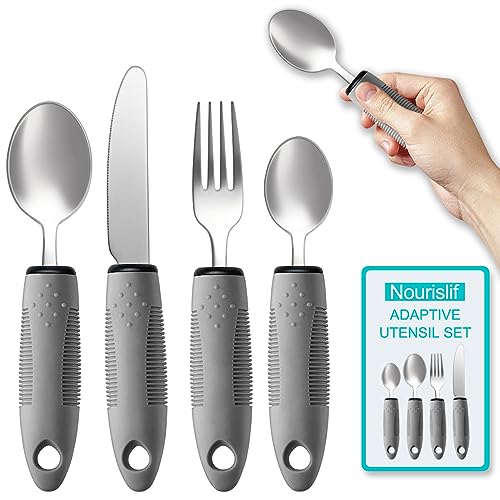
- Four-piece stainless steel set
- 1.25-inch contoured handles
- Each utensil weighs 2.5 ounces
Best For: Adults needing a wider, lightweight grip
Best Customizable Grip

- Three utensils bend to a preferred angle
- Wide grip with palm-aligned ribs
- Designed for right- or left-handed use
Best For: Users who need adjustable utensil positioning
Steady-Grip Pick
Nourislif Weighted 3-Piece Set

- 2.7-ounce weighted utensils
- Fork, knife, and tablespoon included
- Dishwasher safe with one-year guarantee
Best For: Adults seeking a compact weighted set for daily meals
Full-Meal Value Set
Uiifan 10-Piece Adaptive Utensils

- Two sets with 10 total pieces
- Curved knife supports one-handed cutting
- Wide non-slip silicone and plastic handles
Best For: Users wanting variety and backup utensils for daily meals
Angled Control Choice
45° Weighted Adaptive Utensils

- 45° angle helps reduce awkward wrist movement
- 2.5- to 2.9-ounce weighted design
- Textured oversized silicone handles
Best For: Users needing angled, weighted support for tremors or limited stability
Best Adjustable Fit
90° Angled Weighted Spoon and Fork Set

- Adjustable strap supports either hand
- Weighted, non-slip handles aid control
- Food-grade stainless steel construction
Best For: Users seeking a customizable two-piece set for tremors or weak grip
Best Complete Set
45° Angled Weighted Adaptive Utensils
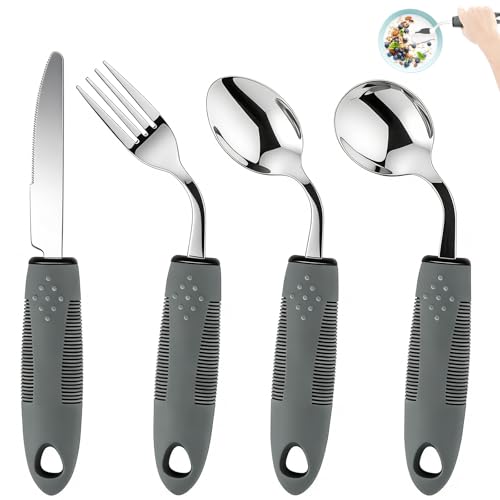
- Four-piece spoon and fork set
- 2.5–2.9-ounce weighted utensils
- Dishwasher-safe silicone and stainless steel
Best For: Right-handed users wanting a fuller everyday utensil set
Best Flexible Design
Bendable Black Spoon and Fork Set

- Rotates to different angles
- Works for left- or right-handed users
- Dishwasher-safe stainless steel and rubber
Best For: Users needing simple angle adjustment without a fixed hand orientation
Best Travel-Ready Set – BUNMO Adaptive Utensils
For shoppers comparing adaptive utensils for one handed use, the BUNMO set combines lightweight, non-slip foam handles with a curved rocker knife that can help reduce the need for a sawing motion. Its four-piece design also packs neatly for meals away from home.
Best For: Older adults and users with tremors or weak hand grips who want a portable set for daily meals and dining out.
Pros:
- Includes a fork, tablespoon, teaspoon, and curved rocker knife.
- Soft, lightweight foam handles provide a cushioned, non-slip grip.
- Reusable canvas travel wrap keeps the set organized and portable.
- Rust-resistant stainless steel utensils are dishwasher safe.
Cons:
- The set has foam handles rather than bendable utensils for customized positioning.
- The included wrap adds portability but may not replace a dedicated storage case for larger accessories.
The BUNMO set is a practical choice when comfort, simple handling, and travel organization matter. Its rocker knife and enlarged grips make it especially useful for users seeking more control without a complicated setup.
Best Plate-Stabilizing Aid – One-Handed Gadget Mat Set
Although it is not a utensil set, this five-piece mat kit can complement adaptive utensils for one handed use by helping keep plates and bowls from sliding. The reusable, transparent mats can also support one-handed opening of some small bottles.
Best For: Users who need extra dinnerware stability while eating, mixing food, or handling small containers with one hand.
Pros:
- Designed to provide anti-slip and anti-spill support for plates and bowls.
- Transparent mats are intended to be discreet under dinnerware.
- Reusable five-piece package offers multiple mats for household use.
- Can also help secure some small bottles and other objects.
Cons:
- Does not include forks, spoons, knives, or other eating utensils.
- The supplied notes do not specify dishwasher care or exact mat material.
This is best viewed as a supporting accessibility accessory rather than a direct alternative to adaptive silverware. It may be useful when sliding dinnerware is the main obstacle to more independent meals.
Best Lightweight Built-Up Set – Nourislif Adaptive Utensils
The Nourislif set is a straightforward option among adaptive utensils for one handed use, with enlarged 1.25-inch handles designed to support stability and control. Each lightweight utensil weighs 2.5 ounces and is made for convenient daily use.
Best For: Adults with arthritis, hand tremors, Parkinson’s, or weak grip who prefer a conventional four-piece silverware set with wider handles.
Pros:
- Includes a fork, knife, tablespoon, and teaspoon.
- Contoured, built-up handles are 1.25 inches wide for easier gripping.
- Lightweight design may help reduce effort during meals.
- Rustproof stainless steel construction is dishwasher safe.
Cons:
- The handles are built up but are not described as foam or non-slip.
- The set does not include a travel wrap or storage case.
Nourislif keeps the design simple and familiar, making it a sensible pick for users who mainly need a wider, lighter grip. The included one-year guarantee adds reassurance for buyers evaluating everyday durability.
Best Customizable Grip – Bendable Adaptive Utensils
For shoppers seeking adaptive utensils for one handed use with adjustable positioning, this four-piece set stands out because the fork, tablespoon, and teaspoon can be bent to the user’s preferred angle. Its wide grips and ambidextrous design support different hand positions.
Best For: Right- or left-handed users with arthritis, tremors, Parkinson’s, or poor grip strength who benefit from customized utensil angles.
Pros:
- Includes bendable fork, tablespoon, teaspoon, and dinner knife.
- Three utensils can be adjusted to the user’s preferred position.
- Wide handles and palm-aligned ribs are designed to improve control.
- Suitable for both right- and left-handed users and dishwasher safe up to 125 degrees.
Cons:
- The knife is not described as bendable; its ribs fit both hands instead.
- The supplied notes do not specify handle width, weight, or included storage.
This set is the strongest fit when adjustability is more important than portability or a soft foam grip. Its bendable components allow users to experiment with positioning for a more natural eating angle.
Steady-Grip Pick – Nourislif Weighted 3-Piece Set
For shoppers comparing adaptive utensils for one handed use, the Nourislif set focuses on a steady, comfortable grip in a compact three-piece package. Each utensil is weighted at 2.7 ounces and designed for people managing hand tremors, arthritis, Parkinson’s, weak grip, or dexterity challenges.
Best For: Adults who want a simple weighted fork, knife, and tablespoon set for everyday meals.
Pros:
- Weighted 2.7-ounce design may provide a steadier feel while eating.
- Built-up handles are intended to make gripping easier.
- Includes a fork, knife, and tablespoon made from rustproof stainless steel.
- Dishwasher safe and backed by a one-year guarantee.
Cons:
- The set includes only three utensils.
- The supplied details do not specify a one-handed cutting design.
This is a straightforward choice if you prioritize weighted, easy-grip silverware over a large assortment. Its dishwasher-safe construction and included guarantee add convenience for regular use.
Full-Meal Value Set – Uiifan 10-Piece Adaptive Utensils
If you need adaptive utensils for one handed use across different meals, the Uiifan set offers two 10-piece sets with several utensil styles. Its curved knife is specifically designed for easier one-handed cutting, while the wider silicone-and-plastic handles support grip and control.
Best For: Households that want multiple utensil types and extra sets for daily use without frequent washing.
Pros:
- Includes two sets totaling 10 pieces, including forks, knives, curved knives, dinner spoons, and soup spoons.
- Curved knife is designed for one-handed cutting.
- Wider, non-slip handles are intended to improve comfort and control.
- Stainless steel utensils resist corrosion and rust.
Cons:
- The utensils are described as non-weighted.
- The larger quantity may be more than needed for shoppers seeking a basic set.
- The supplied details do not state that the set is dishwasher safe.
Uiifan stands out for versatility and quantity rather than added weight. It is a practical option when one-handed cutting and a broad selection of serving shapes matter most.
Angled Control Choice – 45° Weighted Adaptive Utensils
These adaptive utensils for one handed use combine a 45° angle with weighted construction to make bringing food to the mouth more manageable. The fork and spoon angle is intended to reduce awkward wrist movement, while textured silicone handles provide a secure grip for users with tremors or limited hand stability.
Best For: People with Parkinson’s, arthritis, hand tremors, or stroke-recovery needs who may benefit from angled and weighted utensils.
Pros:
- 45°-angled fork and spoon can help reduce wrist strain and awkward movements.
- Utensils weigh between 2.5 and 2.9 ounces for a steadier hold.
- Oversized textured silicone handles support a non-slip grip.
- Rust-resistant stainless steel heads and food-grade silicone handles are dishwasher safe.
Cons:
- The set contains four pieces, so it offers fewer items than the Uiifan option.
- Added weight may not suit users who prefer lightweight utensils.
- The supplied details do not identify every piece in the four-piece set.
This set is the most specialized option of the three, pairing an angled design with moderate weighting. Consider it when wrist positioning and tremor support are higher priorities than having a large utensil assortment.
Best Adjustable Fit – 90° Angled Weighted Spoon and Fork Set
For shoppers comparing adaptive utensils for one handed use, this spoon-and-fork set emphasizes a secure palm fit, adjustable positioning, and added weight. Its strap-supported, non-slip handles and 90° angled design may help users with tremors, weak grip, or limited wrist and elbow mobility manage meals more comfortably.
Best For: Users who want adjustable straps, weighted stability, and bendable 90° positioning in a two-piece set.
Pros:
- Adjustable strap fits most palms and supports use with either hand.
- Wide non-slip grip is designed to improve control.
- Weighted, 90° angled design can support users with tremors or stiff wrists and elbows.
- Food-grade stainless steel is rust-resistant, durable, and easy to clean.
Cons:
- Includes only one spoon and one fork.
- The strap and 90° angled design may require adjustment to find the preferred fit.
This is a versatile choice when fit customization matters as much as stability. The adjustable strap and bendable angle distinguish it from simpler built-up utensil designs.
Best Complete Set – 45° Angled Weighted Adaptive Utensils
This four-piece option is a practical pick for adaptive utensils for one handed use when you want a coordinated set for everyday meals. The right-handed spoon and fork designs use a 45° angle, approximately 2.5–2.9-ounce weighting, and oversized textured silicone handles to promote steadier handling.
Best For: Right-handed users who want a four-piece, dishwasher-safe set with angled utensils and textured grips.
Pros:
- Four-piece set provides multiple spoon and fork utensils.
- Built-in 45° angle is designed to reduce wrist strain and movement.
- Weighted construction may improve stability for hand tremors.
- Food-grade silicone handles and stainless steel are dishwasher safe.
Cons:
- Designed for right-handed use.
- Weight may not suit users who find heavier utensils tiring.
Choose this set if quantity and easy cleanup are priorities. Its fixed angle and right-handed orientation make it less flexible than ambidextrous or manually bendable alternatives.
Best Flexible Design – Bendable Black Spoon and Fork Set
If you need adaptive utensils for one handed use with a simple, flexible setup, this two-piece black set offers a manually bendable design. The spoon and fork can be rotated to different angles, and the ambidextrous construction allows either left- or right-handed users to select a comfortable orientation.
Best For: Users who prioritize adjustable angles, ambidextrous use, and a lightweight two-piece set.
Pros:
- Flexible utensils can be rotated to suit the user’s preferred angle.
- Ambidextrous design accommodates left- and right-handed users.
- Food-grade stainless steel and rubber construction.
- Dishwasher safe for convenient cleaning.
Cons:
- This set is not described as weighted for tremor control.
- Includes only one spoon and one fork.
This is the most orientation-flexible choice of the three, especially for households sharing adaptive utensils between left- and right-handed users. Consider another option if added weight is an important part of your tremor-management strategy.
How We Picked the Best Adaptive Utensils for One Handed Use
We focused on the features that matter most during one-handed eating: handle comfort, utensil stability, useful weight, angle, adjustability, and overall set contents. The selection includes complete four-piece sets, smaller spoon-and-fork combinations, bendable utensils, and multipiece options for households that need backups or several place settings.
Because hand strength and control vary widely, no single design is best for everyone. A lightweight foam handle may suit someone with fatigue or weak grip, while a weighted or angled utensil can provide more stability for tremors or difficulty positioning the wrist.
Quick Comparison
| Design | Best for | Main advantage |
|---|---|---|
| Built-up foam handles | Weak grip, arthritis, fatigue | Comfortable, easy-to-hold shape |
| Weighted utensils | Tremors and shaky movements | Added mass may improve control |
| Angled utensils | Limited wrist mobility | Reduces the wrist angle needed to reach the mouth |
| Bendable utensils | Individual positioning needs | Can be adjusted for a more natural path |
| Large multipiece sets | Caregivers and shared households | Extra utensils and replacement options |
Key Buying Factors for Adaptive Utensils for One-Handed Use
Handle Size and Grip Texture
Look for a handle that fills the hand without requiring a tight pinch. Foam, rubberized, or contoured grips can be more comfortable than thin standard cutlery. Check whether the material stays secure when wet and whether the handle can be cleaned thoroughly.
Weight and Balance
Weighted utensils may dampen some shaking, but extra weight can increase fatigue for users with limited strength. Consider the utensil’s total weight, not just the handle, and choose a balanced design that does not feel front-heavy.
Angle and Adjustability
A 45-degree or bendable design may help users who cannot comfortably rotate or lift the wrist. Adjustable models offer flexibility, but they should hold their position firmly during use. Confirm that the utensil can be positioned for the user’s dominant hand.
Set Contents and Maintenance
Check whether the package includes a knife, fork, teaspoon, and tablespoon, or only the pieces used most often. Dishwasher compatibility, corrosion-resistant materials, and replaceable or removable grips can simplify long-term care.
Who Should Buy Which Adaptive Utensils for One Handed Use?
- For weak grip or arthritis: Choose lightweight utensils with thick, soft, non-slip handles.
- For hand tremors: Consider a moderately weighted set, provided the user can lift it comfortably.
- For Parkinson’s or limited wrist motion: Angled or bendable utensils may reduce awkward wrist movement.
- For caregivers: A larger multipiece set can provide backups and accommodate different users.
- For uncertain needs: Start with a simple spoon-and-fork set, then add angled, weighted, or bendable pieces after observing what causes the most difficulty.
Adaptive utensils can support independence, but persistent difficulty eating, choking, or sudden changes in coordination warrant advice from an occupational therapist or healthcare professional.