Finding the right utensils can make everyday meals easier when small hands, limited grip strength, tremors, or joint pain affect control. The best adaptive designs focus on comfortable handles, manageable weight, and angles that reduce wrist strain.
We compared 10 assistive utensil sets and individual pieces to help you identify the right balance of stability, reach, adjustability, and ease of cleaning for the user.
Best 10 Adaptive Utensils for Small Hands Picks for 2026
Portable Comfort Pick
BUNMO Foam-Grip Adaptive Utensils

- Lightweight foam handles
- Four-piece set with rocker knife
- Includes reusable travel wrap
Best For: Portable, cushioned grip support for everyday meals
Focused Spoon Support
Rehabilitation Advantage Offset Spoon
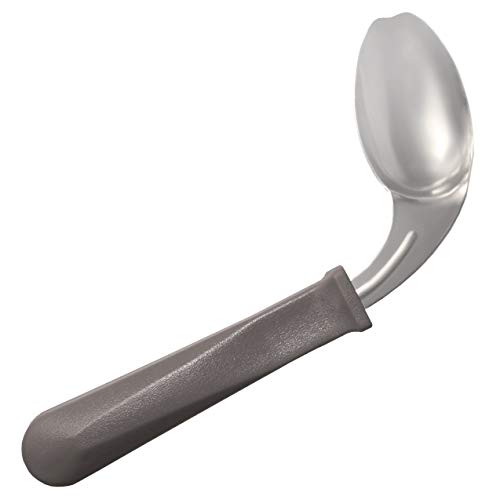
- Right-handed offset design
- 4.5-inch plastic grip handle
- Dishwasher safe to 180 degrees
Best For: Targeted spoon assistance for limited wrist movement
Adjustable Weighted Set
Holotap 270-Degree Adaptive Utensils

- Bends up to 270 degrees
- Weighted non-slip handles
- Complete four-piece set
Best For: Users needing adjustable angles and tremor support
Stability-Focused Design
42-Degree Angled Weighted Utensils

- Fixed 42-degree angle
- 2.5-ounce weighted design
- Textured silicone handles
Best For: Right-handed users wanting angled, steady-hand support
Best Multipack

- Two 10-piece sets
- Wide, comfortable handles
- Includes curved one-hand knives
Best For: Households needing varied adaptive utensils for daily meals
Best Adjustable Fit

- 360-degree angle adjustment
- Adjustable securing strap
- Works for left- or right-handed users
Best For: Users needing added stability and flexible utensil positioning
Best Weighted Trio

- Three essential utensils
- 2.7-ounce weighted pieces
- Dishwasher-safe stainless steel
Best For: Users wanting a compact weighted set for steadier eating
Easy-Grip Pick
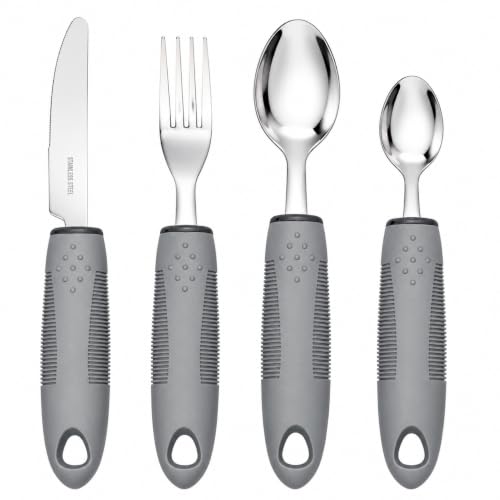
- Non-slip ergonomic handles
- Four-piece everyday set
- Dishwasher-safe construction
Best For: Users who need basic grip support and a complete adaptive place setting
Stable Grip Choice
Weighted-Style Adaptive Flatware

- Wide textured handles
- Four stainless steel utensils
- Dishwasher safe
Best For: Users seeking a substantial grip for tremors, arthritis, or weak hand strength
Angled Stability Pick
KintKita Weighted Angled Utensils
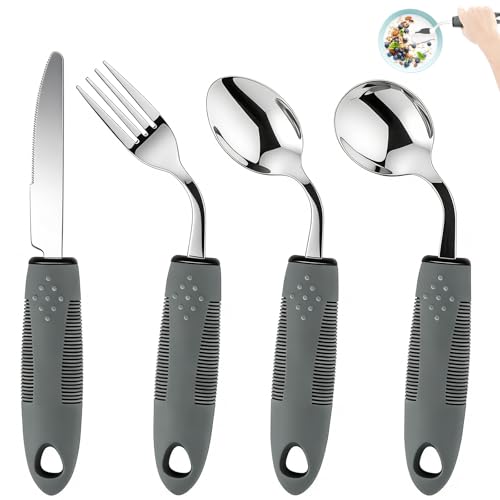
- 45° angled spoon and fork
- Approximately 2.5–2.9 oz each
- Textured silicone grip
Best For: Right-handed users needing added stability and reduced wrist strain
Portable Comfort Pick – BUNMO Foam-Grip Adaptive Utensils
For shoppers comparing adaptive utensils for small hands, the BUNMO set offers lightweight foam handles designed to reduce strain while adding a cushioned, non-slip grip. Its compact four-piece assortment and travel wrap make it practical for everyday meals at home or away.
Best For: Users who want lightweight, portable utensils with soft, easy-grip handles.
Pros:
- Soft, lightweight foam handles provide cushioning and a non-slip grip.
- Includes a fork, tablespoon, teaspoon, and curved rocker knife.
- Reusable canvas wrap keeps the set organized for travel.
- Rust-resistant stainless steel utensils are dishwasher safe.
Cons:
- The large foam handles may not suit users who prefer slim handles.
- The set is designed around general grip support rather than adjustable positioning.
The BUNMO set is a strong everyday option when portability, comfort, and simple grip assistance matter most. The rocker knife is a useful addition for cutting without a sawing motion.
Focused Spoon Support – Rehabilitation Advantage Offset Spoon
When comparing adaptive utensils for small hands, this right-handed offset spoon keeps the design focused and straightforward. Its angled construction and grip-easy plastic handle are intended to help users with limited wrist or hand range of motion maintain more control.
Best For: Right-handed users who need a single spoon for limited wrist mobility or dexterity challenges.
Pros:
- Offset design can help reduce the wrist and hand movement needed for eating.
- Includes a 4.5-inch plastic grip handle.
- Lightweight stainless steel spoon is dishwasher safe up to 180 degrees.
- Useful for therapy and independence-training settings.
Cons:
- It is a single spoon rather than a complete utensil set.
- Designed for right-handed use.
- The handle is plastic rather than a soft foam or silicone grip.
This spoon is a practical choice when a user needs targeted assistance rather than a full adaptive place setting. Its right-handed offset format makes hand and wrist limitations the key fit considerations.
Adjustable Weighted Set – Holotap 270-Degree Adaptive Utensils
For adaptive utensils for small hands that need more positioning flexibility, the Holotap set combines weighted handles with metal utensils that can be bent up to 270 degrees. Built-up non-slip handles and an enlarged spoon are aimed at improving control for users with tremors, reduced grip strength, or limited dexterity.
Best For: Users who need adjustable angles, added handle weight, and a complete four-piece set.
Pros:
- Utensils can be adjusted up to 270 degrees for a more comfortable angle.
- Weighted, built-up handles support control and grip stability.
- Includes a fork, knife, tablespoon, and enlarged teaspoon.
- Stainless steel construction is rust resistant and dishwasher safe.
Cons:
- The 1.25-inch-wide handles may feel broad for some smaller hands.
- Weighted handles may not be ideal for users who fatigue easily.
The Holotap set stands out for its combination of adjustability and weighting. It is worth considering when a fixed utensil angle is not comfortable, but shoppers should compare the built-up handle width with the user’s hand size.
Stability-Focused Design – 42-Degree Angled Weighted Utensils
Among adaptive utensils for small hands, this right-handed set emphasizes a fixed 42-degree angle and moderate 2.5-ounce weighting. Large textured silicone grips are designed to reduce wrist rotation and provide steadier handling for users with tremors, arthritis, or limited dexterity.
Best For: Right-handed users seeking angled, weighted utensils with textured silicone handles.
Pros:
- 42-degree angle is designed to reduce wrist rotation and fatigue.
- 2.5-ounce weighting adds stability without the heavier weight listed for some alternatives.
- Large textured silicone handles provide a non-slip grip.
- Dishwasher-safe stainless steel eating surfaces support daily use.
Cons:
- The right-handed configuration limits suitability for left-handed users.
- Large handles may be less comfortable for very small hands.
- The supplied notes describe a four-piece set but specifically list fork, knife, and soup spoon contents, so shoppers should verify the exact pieces.
This set is geared toward users who benefit from a consistent angled position and weighted stability. Its grip size and right-handed orientation should be checked carefully before purchase, especially for smaller hands.
Best Multipack – Uiifan Adaptive Utensils Set
For shoppers comparing adaptive utensils for small hands, the Uiifan set offers wide, silicone-and-plastic handles intended to improve grip and control. Its two 10-piece sets include several utensil styles for everyday meals.
Best For: Households wanting multiple utensil options for weak grip strength, arthritis, Parkinson’s, or hand tremors.
Pros:
- Includes two sets with forks, knives, curved knives, dinner spoons, and soup spoons.
- Wide handles are designed for comfortable gripping and control.
- Stainless-steel utensils are corrosion- and rust-resistant.
- Curved knives support one-handed cutting.
Cons:
- The approximately 7.5-inch utensils may be larger than some small-hand users prefer.
- The set is non-weighted, so it may not suit shoppers specifically seeking weighted silverware.
Choose this set when quantity and utensil variety matter most. Its built-up handles may help small hands maintain a steadier grip, though the average adult-oriented dimensions are worth checking before purchase.
Best Adjustable Fit – Swivel Fork and Spoon Set
For adaptive utensils for small hands, this swivel fork-and-spoon set stands out for its adjustable angle and securing strap. The design is intended to help users with limited hand movement bring food to the mouth more independently.
Best For: Left- or right-handed users with tremors, arthritis, neuropathy, reduced grip strength, or limited hand mobility.
Pros:
- 360-degree swivel design adjusts to different angles.
- Adjustable strap helps secure the utensil in the hand.
- Non-slip handle is designed for a stable, comfortable grip.
- Rounded, polished edges and food-grade stainless steel support comfortable use.
Cons:
- The set focuses on a fork and spoon rather than a full collection of meal utensils.
- The bright red color may not suit every table setting.
This is a practical choice when hand positioning and utensil stability are bigger concerns than having a complete cutlery set. The angle adjustment can also accommodate either hand.
Best Weighted Trio – Nourislif Easy-Grip Utensils
Shoppers seeking adaptive utensils for small hands may appreciate this compact three-piece set with built-up handles and 2.7-ounce weighted pieces. It includes the basic utensils needed for many meals and is designed for users with tremors or reduced grip strength.
Best For: Individuals who prefer a small, weighted fork, knife, and tablespoon set for everyday eating.
Pros:
- Includes a tablespoon, knife, and fork for essential meal use.
- Each utensil weighs 2.7 ounces to provide added steadiness.
- Built-up handles are designed to support an easier grip.
- Rustproof stainless steel is dishwasher safe.
Cons:
- Only three utensils are included, with no soup spoon or curved knife.
- Added weight may not be comfortable for every small-hand user.
This set makes sense for buyers who want a simple, dishwasher-safe trio rather than a large assortment. Consider whether the 2.7-ounce weight per utensil matches the user’s strength and comfort needs.
Easy-Grip Pick – Compact Adaptive Utensils Set
For shoppers comparing adaptive utensils for small hands, this four-piece set focuses on ergonomic, non-slip handles that can make everyday eating more manageable when grip strength or dexterity is limited. It includes the basic utensils needed for daily meals and is dishwasher safe for convenient cleanup.
Best For: Adults with weak hand grip, tremors, arthritis, Parkinson’s, or stroke-related motor challenges who want a versatile utensil set.
Pros:
- Ergonomic, non-slip handles support a more secure hold.
- Includes a fork, knife, spoon, and additional utensil for daily use.
- Food-safe construction is dishwasher safe.
- Designed to help reduce hand fatigue during meals.
Cons:
- The notes do not specify the handle dimensions, so fit for very small hands should be confirmed.
- No weighting or angled design is identified in the supplied details.
This is a straightforward option when grip support and a complete place setting matter most. Its non-slip handles may suit users seeking easier control, but shoppers specifically needing weighted or angled utensils may prefer a more specialized design.
Stable Grip Choice – Weighted-Style Adaptive Flatware
Among adaptive utensils for small hands, this set emphasizes built-up, textured handles for users who find traditional thin silverware difficult to control. The four-piece stainless steel set is designed for hand tremors, arthritis, weak grip strength, and limited dexterity, with dishwasher-safe construction for routine use.
Best For: Seniors and adults with tremors, Parkinson’s, arthritis, or weak grip strength who want wide, non-slip handles and a complete daily flatware set.
Pros:
- Wide, textured handles provide a more substantial grip.
- Weighted-style design is intended to improve stability and reduce spills.
- Includes a tablespoon, teaspoon, fork, and knife.
- Rust-resistant stainless steel is dishwasher safe.
Cons:
- The built-up handles may feel large rather than ideal for every small hand.
- The supplied notes do not provide exact utensil weights.
This set is a practical choice for shoppers prioritizing handle stability and durable stainless steel. Because the handles are described as wide and built up, check the dimensions or user fit carefully if small-hand comfort is the main concern.
Angled Stability Pick – KintKita Weighted Angled Utensils
For those evaluating adaptive utensils for small hands, the KintKita set combines oversized textured silicone handles with approximately 2.5–2.9-ounce weighting and a 45° angle on the spoon and fork. That combination is intended to support steadier movement and reduce wrist strain for right-handed users.
Best For: Right-handed users with hand tremors, Parkinson’s, arthritis, stroke recovery needs, or weak grip who may benefit from angled and weighted utensils.
Pros:
- 45° angled spoon and fork can help reduce wrist movement and strain.
- Each utensil is weighted at approximately 2.5–2.9 ounces for added stability.
- Oversized textured silicone handles improve traction.
- Rustproof stainless steel and food-grade silicone are dishwasher safe.
Cons:
- The design is specified for right-handed use.
- Oversized handles may not suit every user looking for a compact small-hand fit.
- Added weight may not be comfortable for users who fatigue easily.
This is the most specialized option of the three, pairing angled utensils with measured weighting and high-traction handles. It is worth considering when tremor control and wrist positioning are priorities, provided the right-handed design and larger handle profile fit the user.
How We Picked the Best Adaptive Utensils for Small Hands
We focused on features that matter most during daily meals: handle diameter and texture, total utensil weight, grip security, spoon and fork angles, adjustability, and the range of pieces included. We also considered whether each design appears better suited to mild coordination challenges, significant tremors, arthritis, or reduced hand strength.
Because comfort and control are highly personal, this list includes several formats rather than treating one style as universally best. Built-up handles can be easier to hold, while weighted or angled utensils may help users guide food with less wrist movement.
Quick Comparison
| Design | Best for | What to check |
|---|---|---|
| Built-up handles | Weak grip or arthritis | Diameter, softness, and nonslip texture |
| Angled utensils | Limited wrist movement | Right- or left-hand orientation |
| Weighted utensils | Tremors or shaky movements | Total weight and user strength |
| Swivel or adjustable designs | Reduced coordination | Locking reliability and cleaning |
| Multi-piece sets | Replacing everyday flatware | Included pieces and storage needs |
Key Buying Factors for Adaptive Utensils for Small Hands
Handle Size and Grip
Small hands generally need a handle that can be held securely without excessive stretching. Look for a moderately built-up, contoured, or foam-covered grip rather than simply choosing the thickest handle available. Nonslip materials are useful when hands are weak, damp, or affected by arthritis.
Weight and Balance
Extra weight can dampen some tremors, but it also demands more strength. A lighter utensil may be better for fatigue or very limited grip power. Pay attention to where the weight sits; a balanced design is often easier to control than one that feels heavy at the bowl or fork head.
Angle and Adjustability
Angled utensils can reduce the wrist rotation needed to bring food to the mouth. Confirm whether the spoon or fork is intended for the right or left hand. Adjustable and swivel models offer flexibility, but their joints should hold firmly and remain easy to clean.
Materials and Maintenance
Check whether the set is dishwasher safe and whether removable grips can trap moisture or food. Stainless steel heads are durable, while soft sleeves may improve comfort. Always follow the manufacturer’s cleaning instructions.
Who Should Buy Which Adaptive Utensils for Small Hands?
Choose a lightweight built-up-handle set for users with weak grip strength, smaller hands, or arthritis-related discomfort. Consider weighted utensils when tremors are the main concern and the user can comfortably lift the added weight. Angled designs suit people who struggle with wrist rotation, while swivel or adjustable utensils may help when hand positioning changes from meal to meal.
If you are unsure, start with one spoon or fork before buying multiple sets. The ideal Adaptive Utensils for Small Hands should feel secure without causing hand fatigue, allow natural wrist positioning, and match the user’s actual strength and coordination needs.