Choosing among treadmills for seniors means prioritizing confidence and control over maximum speed. The strongest options pair gentle startup settings with supportive handrails, accessible controls, and a walking surface that feels stable at every step.
This roundup compares 10 senior-friendly treadmills for home use, including compact walking models, higher-capacity machines, and advanced options suited to recovery-focused exercise.
Best 10 Treadmills for Seniors Picks for 2026
Best Heavy-Duty Support
400 lb Senior Fitness Treadmill

- 400-pound maximum capacity
- Full-length and forward handrails
- 0.3–4 MPH range with shock absorption
Best For: Seniors and recovery users needing extra support and capacity
Best Foldable Design
Redliro Slow-Start Senior Treadmill

- Starts at 0.3 MPH
- Front and long side handrails
- Gas-assisted folding frame with wheels
Best For: Compact homes and gentle rehabilitation walking
Best Display and Deck

- Long floor-mounted anti-slip rails
- Large LCD with heart-rate data
- Shock-absorbing deck for walking
Best For: Stable home walking with easy-to-read metrics
Best App-Controlled Option
Long-Handlebar Senior Treadmill

- Bluetooth app control and tracking
- 0.5–6.0 MPH speed range
- Long rails with heart-rate sensor
Best For: Seniors wanting connected workouts and flexible pacing
Best for Full-Length Support
Extra-Long-Rail Walking Treadmill

- Full-length rails support balance throughout a workout
- 0.5-7.5 MPH range for walking and light cardio
- Wide cushioned belt and 310-pound capacity
Best For: Seniors and recovery users prioritizing stability and simple controls
Best for Gentle Backward Walking

- Starts at just 0.3 MPH with 0.1 MPH adjustments
- Extended side rails and front handrail add support
- Flat deck supports controlled forward or backward walking
Best For: Seniors seeking slow, stable, recovery-oriented walking
Best for Higher Weight Capacity
Foldable 400-Lb Walking Treadmill

- Supports up to 400 pounds with a 47.6-inch belt
- 0.3 MPH start and 0-2% incline provide flexibility
- Soft-drop folding and removable rails aid storage
Best For: Larger or taller users needing a stable, space-conscious treadmill
Best Rehab Support
Advanced Rehab Walking Treadmill
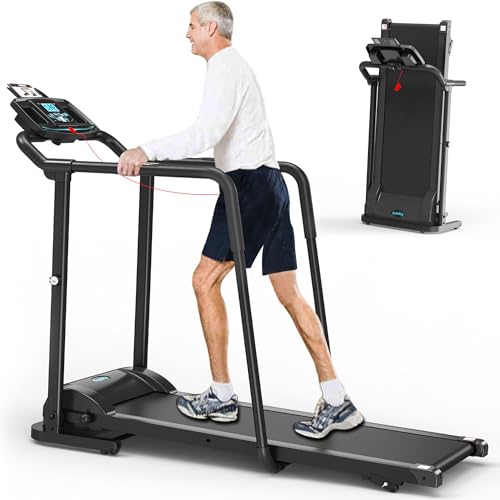
- Extended multi-grip handrails and safety key
- 0.4-8 MPH range with shock absorption
- Bluetooth, folding design, and 12 programs
Best For: Recovery-focused walking and adaptable home workouts
Best Compact Senior Pick
Redliro Long-Handrail Walking Treadmill

- Extended rails support balance and confidence
- 0-2% incline for gentle progression
- Folds, rolls, and includes quiet-use controls
Best For: Small spaces and comfortable daily walking
Best Simple Safety Design
Redliro Full-Length Handrail Treadmill

- Full-length rails and auto-stop safety key
- True 0% start with 1% and 2% options
- Clear controls, wheels, and compact folding
Best For: Steady senior walking with maximum handrail coverage
Best Heavy-Duty Support – 400 lb Senior Fitness Treadmill
For shoppers comparing treadmills for seniors, this Exerpeutic model emphasizes stability, a low starting speed, and substantial weight capacity. Its full-length rails, extra forward handrail, shock-absorbing deck, and simple controls make it suited to careful walking at home.
Best For: Seniors or recovery users who want maximum handrail support and a 400-pound capacity.
Pros:
- Full-length padded rails plus an additional forward handrail provide multiple gripping positions.
- Starts at 0.3 MPH and tops out at 4 MPH for slow, controlled walking.
- Supports up to 400 pounds and includes six shock-absorbing deck cushions.
- Simple start, stop, and speed controls are easy to operate.
Cons:
- Manual incline requires adjustment rather than motorized control.
- It is designed primarily for walking, with a 4 MPH maximum speed.
This is one of the strongest choices for users who prioritize capacity and continuous support over advanced connected features. The 43.5-by-16-inch belt and backlit LCD add practical usability for home walking and recovery routines.
Best Foldable Design – Redliro Slow-Start Senior Treadmill
This Redliro model stands out among treadmills for seniors with a 0.3 MPH starting speed, front and side handrails, and a flat lowest incline setting. Its gas-assisted folding design and wheels also make it practical for apartments or rooms where storage space is limited.
Best For: Seniors, beginners, and rehabilitation users who need slow starts and compact storage.
Pros:
- Begins at 0.3 MPH for controlled, low-impact walking.
- Front and extended side rails offer support from multiple positions.
- Folds with gas-spring assistance, and the side rails can be removed for storage.
- Handrail controls and pulse sensors provide convenient speed and heart-rate monitoring.
Cons:
- The 300-pound capacity is lower than some heavy-duty senior treadmills.
- The 41-inch belt is relatively compact for users with longer strides.
With a flat walking option, self-lubricating deck, and foldable frame, the Redliro balances accessibility with convenience. It is a sensible pick when safe low-speed exercise and easy storage matter more than a larger walking surface.
Best Display and Deck – Wide-Deck Walking Treadmill
For those evaluating treadmills for seniors, this walking treadmill combines floor-mounted long handrails with a wide deck and a large LCD display. It is built around stable stepping, impact reduction, and straightforward access to workout metrics such as speed, distance, calories, and heart rate.
Best For: Seniors who want a stable walking surface, prominent controls, and heart-rate monitoring.
Pros:
- Long anti-slip handrails provide four-point support when stepping on, off, or walking.
- Shock absorption is intended to reduce impact on knees and ankles.
- Large display and oversized buttons make workout information easier to view.
- Supports up to 300 pounds and includes 12 preset modes.
Cons:
- The minimum speed is 0.6 MPH, faster than the slowest options in this roundup.
- The product details do not specify a folding size or exact belt dimensions.
This model focuses on physical stability and readable operation rather than ultra-slow rehabilitation pacing. Its long rails, heart-rate sensors, cup holder, and claimed sub-55-decibel operation make it a practical home walking machine for users comfortable with a 0.6 MPH start.
Best App-Controlled Option – Long-Handlebar Senior Treadmill
This app-connected treadmill offers a blend of long-handrail support, a 41.37-by-14.18-inch walking belt, and a 0.5-to-6.0 MPH range. Among treadmills for seniors, it is especially appealing to users who want remote control, workout tracking, and heart-rate monitoring alongside gentle walking.
Best For: Tech-comfortable seniors who want app control and a wider speed range for walking or light jogging.
Pros:
- Extended ergonomic handlebars help provide balance during walking.
- Bluetooth app control supports remote operation and exercise-data tracking.
- Heart-rate monitoring and 12 preset programs add workout feedback.
- Quiet operation is rated below 45 dB, and the frame supports up to 300 pounds.
Cons:
- The 0.5 MPH minimum is not as slow as the 0.3 MPH models.
- App connectivity may be unnecessary for shoppers seeking the simplest controls.
This is a versatile choice for a senior home gym that may serve both gentle walking and faster exercise. Its app features and 6.0 MPH maximum broaden the workout options, while the long rails, safety key, and cushioned belt retain a senior-focused design.
Best for Full-Length Support – Extra-Long-Rail Walking Treadmill
For shoppers comparing treadmills for seniors, the Lastforever model emphasizes continuous balance support, a roomy cushioned belt, and simple controls. Its gentle 0.5-7.5 MPH range suits slow walking, recovery exercise, and light cardio, while the reinforced frame supports up to 310 pounds.
Best For: Seniors and recovery users who want full-length handrails, a wider walking surface, and straightforward at-home workouts.
Pros:
- Extra-long handrails provide support along the full walking path.
- Wide, five-layer cushioned belt is designed to reduce impact on joints.
- Large LED display and handrail controls reduce the need to bend down.
- Includes 12 programs, app connectivity, transport wheels, and a 310-pound capacity.
Cons:
- The belt is 41.3 inches long, which may feel limiting for users with a longer stride or those who want to run.
- Manual lubrication is required for maintenance.
This is a practical choice when stability and ease of use matter more than high-speed training. Its handrail design and low starting speed are particularly relevant for cautious walkers, while the compact frame and wheels help with home placement.
Best for Gentle Backward Walking – Low-Speed Senior Treadmill
Among treadmills for seniors, this Redliro model stands out for its 0.3 MPH starting speed and reversible deck for forward or backward walking. Extended side rails, a front handrail, and a flat walking surface provide a controlled setup for daily movement or recovery-focused exercise.
Best For: Seniors who need very slow speed adjustments, extra handrail support, or a treadmill designed for backward-walking practice.
Pros:
- Starts at 0.3 MPH with precise 0.1 MPH adjustments for gradual pacing.
- Extended side rails plus a front bar provide multiple points of support.
- Flat, no-incline deck offers a stable walking surface.
- Handrail controls, a screen-off button, mute function, and front wheels add convenience.
Cons:
- Its 5.5 MPH maximum speed is geared more toward walking than faster running.
- The 300-pound weight recommendation is lower than the capacity of some heavier-duty models.
- Backward walking should be attempted only when appropriate for the user’s abilities and support needs.
The low starting speed and reversible design make this a specialized option rather than a general running treadmill. It is most compelling for users who value controlled movement and multiple ways to manage the machine without bending.
Best for Higher Weight Capacity – Foldable 400-Lb Walking Treadmill
For shoppers seeking treadmills for seniors with additional capacity, this Redliro model combines a 400-pound rating with long handrails and a 47.6-inch belt. The 0.3 MPH starting speed, simple display, mild 0-2% incline, and soft-drop folding system make it suitable for home walking and light rehabilitation.
Best For: Larger or taller users who want extra deck space, strong support rails, and a treadmill that can be folded for storage.
Pros:
- 400-pound capacity and a 47.6-inch-long belt provide substantial walking support.
- Front and side long handrails help with stepping on, walking, and getting off.
- Starts at 0.3 MPH and offers 0.1 MPH adjustments for controlled pacing.
- Soft-drop folding, removable handrails, and wheels help with storage and relocation.
Cons:
- The 0-2% manual incline offers only a modest elevation range.
- At 94.3 pounds, moving the treadmill may still require considerable effort despite the wheels.
- The belt width is 16.5 inches, so users wanting a particularly wide running area may prefer a wider model.
This is the strongest capacity-focused option in the group. Its long belt and supportive rails suit users who need more room and stability, while folding features make it more manageable in a home or apartment setting.
Best Rehab Support – Advanced Rehab Walking Treadmill
For shoppers comparing treadmills for seniors, this model emphasizes balance support, gradual speed changes, and flexible use. Its extended multi-grip handrails, low 0.4 MPH starting speed, shock absorption, and safety key make it particularly suited to cautious walking or recovery-focused routines.
Best For: Seniors and recovery users who want extensive handrail support, app connectivity, and a wider speed range for walking or light jogging.
Pros:
- Extended, multi-position handrails provide added stability and can be removed when a conventional treadmill setup is preferred.
- Low 0.4 MPH starting speed, incremental adjustments, and a 287-pound capacity support controlled workouts.
- Shock absorption, three manual incline levels, 12 programs, and an LCD display offer useful training flexibility.
- Bluetooth works with Kinomap, Zwift, and FitShow, while the folding frame and transport wheels help with storage.
Cons:
- The 41.3-by-15-inch deck is more compact than many full-size treadmill surfaces.
- Incline adjustment is manual rather than powered.
- Its maximum speed of 8 MPH may be more capability than some senior walkers need.
This is the most versatile choice of the three for users who want rehabilitation-oriented support today but may later progress to faster walking or jogging. Confirm that the compact deck dimensions and available floor space suit the intended user.
Best Compact Senior Pick – Redliro Long-Handrail Walking Treadmill
This Redliro is a practical option for shoppers seeking treadmills for seniors in an apartment or smaller room. It combines extended support rails with a compact walking belt, gentle manual incline settings, quiet-use controls, and a folding design for easier storage.
Best For: Seniors who prioritize a compact footprint, simple controls, and gentle daily walking at home.
Pros:
- Extended handrails are designed to improve balance and confidence while walking.
- Three manual incline levels from 0% to 2% allow flat or gently elevated walking.
- A mute button, screen-off button, quick-pause function, and 12 programs make everyday use straightforward.
- The 58.6-pound frame has transport wheels, folds for storage, and supports up to 300 pounds.
Cons:
- The 39.3-by-14.8-inch belt is relatively narrow and short.
- The 5 MPH maximum speed is intended more for walking and light jogging than faster running.
- It uses a power cord and does not list Bluetooth connectivity.
Choose this model when space-saving storage and senior-friendly convenience matter more than a large running surface or advanced connectivity. Its low incline range is also appropriate for users seeking modest progression without steep elevation.
Best Simple Safety Design – Redliro Full-Length Handrail Treadmill
For those comparing treadmills for seniors, this Redliro model focuses on continuous support and straightforward operation. Full-length handrails, rail-mounted controls, a true 0% starting incline, and an auto-stop safety key make it suitable for steady walking and recovery-oriented routines.
Best For: Older adults who want full-length handrails, clear controls, easy room-to-room movement, and a gentle walking-to-light-jogging range.
Pros:
- Full-length handrails provide a steady grip across the deck, with an auto-stop safety key for emergencies.
- Manual 0%, 1%, and 2% incline settings allow users to begin on a natural flat surface.
- Large dual-data display, rail buttons, console shortcuts, and a screen-off button simplify operation.
- Supports up to 300 pounds, includes two external wheels, and folds into a compact storage size.
Cons:
- The 39.3-by-14.8-inch walking surface may feel limited for users who need more room.
- Its 0.5-5 MPH range is focused on walking and light jogging rather than running.
- Incline changes are manual, and the supplied details do not list Bluetooth connectivity.
This model is a strong fit when handrail coverage and uncomplicated controls are the top priorities. The 0% starting incline and rail controls are especially practical for users who want to adjust gradually without reaching away from their support.
How We Picked the Best Treadmills for Seniors
We focused on features that can make routine walking more comfortable and predictable: low starting speeds, gradual acceleration, long or full-length handrails, easy-to-reach controls, stable frames, and clearly stated user-weight limits. We also considered whether each treadmill fits common home-use needs, such as light exercise, balance support, recovery walking, or regular low-impact activity.
Because needs vary widely, no single model is best for every user. A treadmill with a very low starting speed may suit cautious walkers, while a faster, incline-capable machine may be more useful for active users who want room to progress.
Quick Comparison
| Feature | Why It Matters | What to Look For |
|---|---|---|
| Starting speed | Helps users begin without a sudden pace change | About 0.2–0.4 MPH for cautious walking |
| Handrails | Provide balance support and confidence | Long, sturdy rails that are easy to grip |
| Weight capacity | Supports stability and appropriate sizing | A rating comfortably above the user’s weight |
| Walking area | Allows a more natural stride | Enough length and width for the user’s gait |
| Controls | Makes speed changes safer and simpler | Large, readable buttons or a straightforward remote |
Key Buying Factors for Treadmills for Seniors
Stability and Handrail Design
Long handrails can be more useful than short front handles because they offer support while stepping on, walking, and slowing down. Look for a solid frame, minimal wobble, and rails positioned at a comfortable height. A safety key or emergency stop feature is also valuable.
Speed Range and Startup
For many older adults, a gentle starting speed matters more than a high top speed. Models beginning around 0.2 to 0.4 MPH can make it easier to establish balance before increasing the pace. Smooth acceleration is preferable to abrupt speed changes.
Capacity, Space, and Access
Check the stated weight limit and leave a reasonable margin rather than choosing a treadmill at its maximum rating. Measure the available space, including room around the rails, and verify the step-up height. A lower deck can be easier to access, but it should still feel secure and well supported.
Rehabilitation and Workout Features
Incline, Bluetooth, app controls, and higher speeds are useful only if they match the user’s goals. For recovery or balance-focused walking, simple controls and dependable support may be more important than extra programs. Consult a medical professional before using a treadmill for rehabilitation.
Who Should Buy Which Treadmills for Seniors?
- For cautious beginners: Choose a low-speed model with long or full-length rails and simple controls.
- For larger users: Prioritize a sturdy frame and a capacity well above the user’s body weight.
- For recovery-focused walking: Look for gentle startup, continuous handrail support, and easy emergency stopping.
- For active seniors: Consider a model with a broader speed range, optional incline, and app or Bluetooth features.
- For compact spaces: Measure carefully and select a walking treadmill that can be stored without blocking access routes.
Before buying, confirm the return policy, assembly requirements, warranty, and availability of replacement parts. The best treadmill is the one the user can approach confidently, operate independently or with appropriate assistance, and use consistently.